Showing posts with label Pasta. Show all posts

Monday, November 16, 2009

Vegetable Lo Mein: A Recipe or Two

Today on Serious Eats: Tomatillo Guacamole. You will want to eat it. Frequently, even.

A few months ago, some bad chicken lo mein taught me everything I ever wanted to know about food poisoning (but was too preoccupied with vomiting to ask). In ten years of professional employment, I’d never called out sick two days in a row. Four days of shivering, fever, and non-stop bathroom trips later, my streak was vanquished, as was my will to live. In retrospect, it was like receiving a continuous gastrointestinal wedgie from God.

Color me paranoid, but since then I’ve been a tad gun-shy about ordering takeout, especially from our local Chinese joints. With exceptions like the Halaal place down the block, they tend to be somewhat less than sanitary. And by “somewhat less than sanitary,” I mean “Oscar the Grouch would find this hellish and oppressive.” Granted, I imagine I wouldn’t want to lick the floor of most restaurant kitchens. But I also can’t see them when I’m ordering, so the illusion is preserved.

Making Chinese food at home has been a good time, though. I’m learning a lot about cabbage and oyster sauce, and have received frequent noodle injections, vital to the happiness of a blogger’s mouth hole. In fact, today’s dish is of the noodle persuasion, and comes from the greatest everyday cookbook there ever was, Cook’s Illustrated Best 30-Minute Recipe.

I’ve used Best 30-Minute time and again on CHG, and it. Has. Never. Failed. Me. If it was a person, I’d make it cake. If it was a President, I’d solve its budget crisis. If it was Big Bird, I’d cooperate with it until it puked.

Anyway, their prescription for Vegetable Lo Mein was delightful, not least because I tried it two ways:

1) Almost exactly as written. CI’s original recipe asks for fresh Chinese egg noodles and 10 ounces of shiitake mushrooms. As shiitakes are dang pricey, I subbed half of them out for regular button mushrooms. The total cost still came to $11 or so, but the results were indisputably good. Earthy, salty, and starchy, it sated every craving I’ve ever had, or ever will have. Pregnancy? I’m ready for you now. (Um … after the wedding of course, Ma.)

2) With cost-cutting tweaks. Alas, $11 is not cheap for a starch-n-veggie dish. So, the second time around, fresh noodles were swapped out for thin spaghetti, and the shiitakes were replaced entirely with button mushrooms. I won’t front – the more expensive version was superior. Still, this was definitely tasty, and at $5 less than dish #1, will be the recipe going into rotation.

One drawback - the recipe isn’t vegetarian. However, it can be made so by substituting veggie broth for chicken broth and vegetarian oyster sauce for the regular stuff. So go crazy, my sweet vegans/veg heads.

In sum, I don’t know if I’ll ever order takeout lo mein again. And not just because last time, it made me violently, violently ill. (Number of barf mentions in this post about food and cooking: three. A new record!)

~~~

If you like this recipe, you might also like:
~~~

Vegetable Lo Mein
Serves 3
Adapted from Cook’s Illustrated Best 30-Minute Recipes.
Print this recipe


8 ounces thin spaghetti
1 tablespoon toasted sesame oil

1 tablespoon vegetable oil
8 ounces button mushrooms, sliced
1 red bell pepper, sliced into thin strips
1 small head Napa (Chinese) cabbage, sliced crosswise into 1/4-ribbons
2 cloves garlic, minced
1 tablespoon grated fresh ginger
1/4 cup low-sodium chicken broth (or veggie)
3 tablespoons soy sauce
3 tablespoons oyster sauce (or vegetarian oyster sauce)
4 scallions

1) Boil spaghetti in salted water until al dente. Drain and rinse with cold water to stop cooking process. Pour cooled spaghetti back into saucepan, add sesame oil, and stir to coat. Set aside.

2) Heat vegetable oil over high in a large, nonstick skillet. Add mushrooms and saute 4 or 5 minutes, until they are browned and have released their water. Add bell pepper and cabbage, and saute another 3 or 4 minutes, until cabbage is mostly wilted. Clear a spot in the middle of the pan, add garlic and ginger, and sauté for 30 seconds, stirring constantly. Add broth, soy sauce, and oyster sauce to mixture, stirring to combine. Bring to a simmer, then kill the heat.

3) Pour cold spaghetti into skillet. Mix thoroughly to warm. Add scallions and serve.

Approximate Calories, Fat, Fiber, and Price Per Serving
471 calories, 11.3 g fat, 10.5 g fiber, $2.00

Calculations
8 ounces thin spaghetti: 810 calories, 4.1 g fat, 8.1 g fiber, $0.33
1 tablespoon toasted sesame oil: 120 calories, 13.6 g fat, 0 g fiber, $0.18
1 tablespoon vegetable oil: 124 calories, 14 g fat, 0 g fiber, $0.09
8 ounces button mushrooms, sliced: 50 calories, 0.7 g fat, 2.3 g fiber, $0.99
1 red bell pepper, sliced into thin strips: 43 calories, 0.5 g fat, 3.4 g fiber, $1.02
1 small head Napa (Chinese) cabbage: 171 calories, 0.7 g fat, 14.3 g fiber, $1.48
2 cloves garlic, minced: 8 calories, 0 g fat, 0.1 g fiber, $0.09
1 tablespoon grated fresh ginger: 5 calories, 0 g fat, 0.1 g fiber, $0.08
1/4 cup low-sodium chicken broth: 4 calories, 0 g fat, 0 g fiber, $0.09
3 tablespoons soy sauce: 25 calories, 0 g fat, 0.4 g fiber, $0.30
3 tablespoons oyster sauce: 28 calories, 0.2 g fat, 0.2 fiber, $0.90
4 scallions: 32 calories, 0.2 g fat, 2.6 g fiber, $0.44
TOTAL: 1412 calories, 34 g fat, 31.5 g fiber, $5.99
PER SERVING (TOTAL/3): 471 calories, 11.3 g fat, 10.5 g fiber, $2.00

Monday, November 9, 2009

Butternut Squash Gnocchi: A Recipe for Victory

Today in my Serious Eats column: Mushroom Risotto. It's like eating Sherwood Forest in the best possible way.

A long, long time ago (2008) in a galaxy far, far away (this very blog) I made potato gnocchi, and promised that a butternut squash version would be not far behind. A-year-and-a-half later (which isn’t too long, when you consider the age of the Earth), here it is. As a depressed and bitter Mets fan, I blame the delay on the Yankees.

(Other things I blame on the Yankees: wedgies, scabies, angina, the continued success of Two and a Half Men, the early cancellation of My So-Called Life, the final season of Roseanne, holes in my socks, rats in my backyard, jalapeno in my eye, “Hotel California,” 311, “Breakfast at Tiffany’s” [the song, not the movie], skunked beer, corked wine, accidentally drinking Gatorade right after brushing my teeth, the word “moist,” owning 27 World Series rings and remaining relatively classy / making it difficult for me to hate them / making me all the more crazed.)

Anyway – gnocchi! It’s one of my favorite dishes in the world, and surprisingly easy to make if you don’t mind a bit of a mess. (Another good messy recipe: Oprah’s Jam Straws.) The butternut squash variety is sweeter than potato gnocchi, and a bit lighter, due to the root veggie’s lower calorie count. I’m ignoring the fact that it’s usually paired with high-fat sage and brown butter sauce, because denial is a fun and constructive pastime.

This particular gnocchi recipe is a mélange of Emeril’s (roasting technique), Sunset’s (ingredients), and a blog called Hungry Craving’s (gnocchi technique). It’s filling without being heavy, which is a result of two things: 1) a good squash-to-flour ratio, and 2) letting the squash dry before combining it with the other ingredients. Beware of wet gnocchi, folks. It falls apart in the pot and is generally the nadir of society.

We have to address the sauce, though, don't we? Okay. Here goes: I find that a little bit of butter never killed anyone (exception: those with butter allergies). However, parmesan is a great topping all by itself, especially since the gnocchi is a bit wet coming out of the pot. A little salt, a little pepper, and you’re good to go. Ready for takeoff. Four on the floor. Lucy in the sky with dia- … I don’t know what I’m talking about.

Anyway, this particular recipe will be the last butternut squash dish for awhile. I’d like to blame the fact that we’ve hit orange foods pretty hard the last few weeks. But, um ... I blame the Yankees. (*shakes fist*)

~~~

If you like this recipe, you might also dig:
~~~

Butternut Squash Gnocchi
Makes between 150 and 200 gnocchi, which serves 4 to 6
Print this recipe.


1 2-lb butternut squash
1 tablespoon olive oil
1 teaspoon salt, divided
1/2 teaspoon white pepper, divided
1/4 teaspoon nutmeg
3 to 4 cups all-purpose flour

1) Preheat oven to 375°F.

2) Slice butternut squash lengthwise. Scoop out seeds and surrounding junk. Rub cut sides of squash with olive oil and sprinkle with 1/2 teaspoon salt and 1/4 teaspoon pepper. Roast face down until easily pierced through with a knife, 45 minutes to 1 hour.


When finished, remove from oven, flip over, and let cool 15 minutes.

3) Once cool enough to handle, scrape squash meat into a large mixing bowl and pulverize it with a potato masher. There should be no lumps whatsoever. Then, spread squash out in the bowl and cool to room temperature. (This took only about 15 minutes for me).


While squash is cooling, bring a very large pot of salted water to a boil.

4) Add remaining 1/2 teaspoon salt, 1/4 teaspoon pepper, and nutmeg to squash. Stir. Then, add one cup of flour and stir until absorbed. Add a second cup, and repeat. The squash should be forming a dough, pulling away from the sides of the bowl. Add a third cup and stir again.


When squash is doughy enough (meaning: not wet and sticky), turn out on to a well-floured surface. Make sure your hands are well-floured, and gently knead dough for a minute or two. Add more flour if dough sticks to surface.

5) Once you have a good dough ball, break off about an eighth of it. Using your hands, carefully roll this piece into a long, thin log, about 1/2 - 3/4 inch in diameter.

6) This is the most important part: using a knife or a pastry scraper, cut off a 3/4-inch piece (not the end piece) of the roll. It should look like a tiny pillow.


7) Drop the piece into your pot of boiling water. When it rises to the top, it's finished. Eat it. If you like it, go ahead to step 8. If it's gummy or falls apart in the water, that means there's too much moisture in the dough. Add more flour (1/8 - 1/4 cup) to your dough ball, knead it in, and try again until you get the result you desire.

8) Chunk by chunk, roll the remaining dough into logs. After each log is made, cut them into 3/4-inch pieces. Each piece should be about the size of the top of your index finger, from knuckle to nail. You can take this opportunity to make the beautifying/sauce-catching fork marks often associated with gnocchi, or, like me, you can skip it and get on with things.


9) Place each piece of gnocchi on a floured or wax paper-lined cookie sheet. This will give you an idea of their numbers AND set them up for freezing later.


10) Drop a full serving (between 20 and 30 gnocchi) into the pot of boiling water. When the gnocchi rise to the surface, remove them with a slotted spoon (or other hole-y implement) and place them into a serving bowl. This should take between 3 and 5 minutes per serving. You may have to drain extra liquid from each bowl at the end.

11) Add sauce or parmesan and dig in.

NOTE: To preserve uncooked gnocchi, simply chill the pan from step #14 in your freezer. When gnocchi is frozen through, dump 'em in a plastic bag, squeeze the air out, and seal. Voila.

Approximate Calories, Fat, and Price Per Serving
Four servings: 589 calories, 4.9 g fat, 8 g fiber, $0.53
Five servings: 471 calories, 3.9 g fat, 6.4 g fiber, $0.43
Six servings: 392 calories, 3.3 g fat, 5.3 g fiber, $0.36

Calculations
1 2-lb butternut squash: 408 calories, 0.9 g fat, 18.1 g fiber, $1.55
1 tablespoon olive oil: 119 calories, 13.5 g fat, 0 g fiber, $0.11
1 teaspoon salt, divided: negligible calories, fat, and fiber, $0.01
1/2 teaspoon white pepper, divided: 4 calories, 0 g fat, 0.3 g fiber, $0.05
1/4 teaspoon nutmeg: 3 calories, 0.2 g fat, 0.1 g fiber, $0.01
3 to 4 cups all-purpose flour (calc is for 4): 1820 calories, 5 g fat, 13.5 g fiber, $0.40
TOTAL: 2354 calories, 19.5 g fat, 32 g fiber, $2.13
PER SERVING (TOTAL/4): 589 calories, 4.9 g fat, 8 g fiber, $0.53
PER SERVING (TOTAL/5): 471 calories, 3.9 g fat, 6.4 g fiber, $0.43
PER SERVING (TOTAL/6): 392 calories, 3.3 g fat, 5.3 g fiber, $0.36

Friday, August 14, 2009

Pasta with Zucchini and Chickpeas. Also ... Squirrel!

Oh, you guys, I love this dish. For real, Pasta with Zucchini and Chickpeas is one of the best, simplest dinners I’ve made in a long time. The zucchini gives it snap, the chickpeas give it heft and fiber, and the pasta … well, pasta is pasta. It’s manna from heaven.

The recipe originally comes from Real Simple, and the only change I made was to reduce the olive oil by a tablespoon. The rest was pretty healthy on its own, and under $1 per serving. Plus, it’s excellent for lunch the next day. Just take care to evenly distribute the chickpeas when you’re serving the dish, or the last recipient will get 75% of those suckers. (I learned this the hard way.)

Sadly - and here’s the catch - the picture I took is butt-terrible. Moreso than usual, even. The bowl and background are yellow and out-of-focus, and the food itself looks like Cthulu. So, to compensate, two things:

A) I used the photo from David Chiu’s website, which might come from Real Simple, but I’m not sure.

B) Squirrel!

Man, I love that thing. If you have some free time, the folks over at Buzzfeed have Photoshopped the Crasher Squirrel (as it has become known) into all kinds of exciting scenarios like this one:

Whee!

Anyway, that’s a wrap for this week. I’m away again next week, so posting will be kind of light, with a guest poster or two. Have a lovely weekend, and don’t forget to squirrel. I mean, make this dish.

Pasta with Zucchini and Chickpeas
Serves 4
Adapted from Real Simple.
Picture from David Chiu possibly via Real Simple.

3/4 lb. pasta like linguine or spaghetti
1 tablespoon olive oil
3 small or 2 medium zucchinis, chopped into ¼-inch half-moons
Kosher salt
2 cloves garlic, minced
1 15-oz can chickpeas, drained and rinsed
1/4 teaspoon crushed red pepper
1/2 cup grated parmesan cheese

1) Cook pasta in salted water until al dente. Drain, making sure to keep 1/2 cup of pasta water for later.

2) While pasta is cooking, heat oil in a large nonstick skillet over medium high heat. Add zucchini. Add 1/2 teaspoon kosher salt. Saute 4 or 5 minutes. Add garlic, chickpeas, and red pepper. Saute an additional 2 or 3 minutes. Kill heat.

3) Add pasta, your reserved pasta water, and 1/4 cup parmesan to skillet. Stir to combine. Serve with remaining parm sprinkled on top, take care to evenly distribute the chickpeas.

Calories, Fat, Fiber, and Price Per Serving
542 calories, 9.6 g fat, 8.5 g fiber, $0.97

Calculations
3/4 lb. pasta like linguine or spaghetti: 1262 calories, 5.1 g fat, 10.9 g fiber, $0.60
1 tablespoon olive oil: 119 calories, 13.5 g fat, 0 g fiber, $0.11
3 small or 2 medium zucchinis: 63 calories, 0.8 g fat, 4.3 g fiber, $0.85
Kosher salt: negligible calories, fat or fiber, $0.02
2 cloves garlic, minced: 9 calories, 0 g fat, 0.1 g fiber, $0.10
1 15-oz can chickpeas, drained and rinsed: 500 calories, 4.6 g fat, 18.5 g fiber, $0.80
1/4 teaspoon crushed red pepper: negligible calories, fat or fiber, $0.02
1/2 cup grated parmesan cheese: 216 calories, 14.3 g fat, 0 g fiber, $1.36
TOTAL: 2169 calories, 38.3 g fat, 33.8 g fiber, $3.86
PER SERVING (TOTAL/4): 542 calories, 9.6 g fat, 8.5 g fiber, $0.97

Monday, July 20, 2009

Seriously, Eating: 40 Recipes From the Other Website I Write For

Today, I had every intention of posting on David Lebovitz’s Cherry Jam recipe. Unfortunately, I think I overcooked it a bit, so it came out more like Cherry Swedish Fish. Between that and a busy work week, I ain’t got nothin’.

So, instead, here are 40 other recipes I’ve been working on.

I’m only half kidding about that, too. See, for the last 11 months, I’ve been writing the Monday morning Healthy and Delicious recipe column for Serious Eats. (I never cross-post, because that would be weird.) The food follows the CHG mantra (meaning it’s all cheap, healthy, and good), and the pictures are even marginally acceptable by modern photographic standards, meaning Ansel Adams wouldn’t make me his apprentice, but he wouldn’t hack me to death with a chainsaw, either.

Today’s SE recipe is Cherry Lemonade, and you can find that over here. (It’s not included in this master list.) In the meantime, here are the 40 others I mentioned. I starred my ten absolute favorites, and need to tell you: make that Chicken Avocado Salad RIGHT NOW. It haunts my dreams.

BREAKFAST

Cardamom and Dried Cherry Scones

Cheddar Chipotle Scones

Lighter Home Fries


SOUPS, STEWS, STOCKS, & CHILIS

Curried Cauliflower Soup with Honey

Pasta e Ceci

**Roasted Butternut Squash Soup

**Tomato Soup with Roasted Garlic and Herbs

**White Chicken Chili


SIDES

Black-Eyed Pea “Caviar”

Classic Baked Acorn Squash

Couscous with Chickpeas and Edamame

Fresh Corn Salad

**Golden-Crusted Brussels Sprouts

Irio

Lemon Basil Pasta Salad

Quinoa and Grilled Zucchini

Red Cabbage with Apples and Honey

Southern-Style Black-Eyed Peas with Bacon

Thyme-Roasted Sweet Potatoes


ENTREES (Vegetarian)

Barley Risotto

**Black Bean and Tomato Quinoa

Eggplant in Spicy Tomato Sauce

Eggplant with Miso Sauce

Grilled Zucchini with Quinoa Stuffing

**Pumpkin Orzo with Sage

**Spaghetti Squash with Ricotta, Sage, and Pine Nuts

Sweet and Spicy Tofu


ENTREES (Carnivore)

*****Avocado Chicken Salad

Baked Apples with Barley-Sausage Pilaf

Baked Rotelle Puttanesca (has anchovies)

Basil Chicken Pasta

Chicken Paprikash

Curried Pork with Apples

**Marcella Hazan’s Lemon Roasted Chicken with Carrots and Potatoes

Squid in Red Wine Sauce


DESSERTS & SNACKS

Blueberry Salsa

**Pumpkin Muffins with Pecan Streusel Topping

Quick and Easy Apple Tart

Raspberry-Filled Cinnamon Muffins

Sugar-Roasted Plums with Balsamic and Rosemary Syrup

Also, if you guys get the chance, check out Blake Royer and Nick Kindelsperger's Dinner Tonight series. The posts are daily, the food is very good (I've tried a bunch of recipes), and nothing is phenomenally complicated. Three thumbs up.

Friday, May 29, 2009

Pasta with Eggplant, Zucchini, and Tomatoes, Plus a Very Important Question

(Readers! Leigh of Veggie Might fame is looking for suggestions for future columns. If you can buzz in with a few ideas, 'twould be ever so lovely. Woot!)

Normally, this is where we talk about food. But earlier this week, I had a dream. I was in the dream as myself, and a man – I couldn’t really see his face – asked me a clear, pointed question that I considered very seriously, but could not answer. Since then, I’ve spent my waking hours pondering the ins and outs of the inquiry, with no definitive conclusion.

That question was this: “Is Frankenstein technically a zombie?”

Compared to queries like “What is the soul?” and “Why is the sky blue?” it’s relatively minor, but SWEET BEA ARTHUR the dang thing’s been killing me. You can argue it every which way, and I’m borderline convinced there’s no real solution.

I’m tempted to say yes, Frankenstein IS a zombie, as he is reanimated tissue – a dead guy brought back to semi-life through artificial, somewhat supernatural means. His only real pastime is lurching, and while he doesn’t quite seem homicidal (as zombies naturally are), the possibility for destruction is always there. Essentially, he’s a mindless corpse, which is the very definition of a zombie.

The Husband-Elect argues that Frankenstein has a beating heart and a borderline working brain, making him fundamentally alive. (Zombies being mostly dead, with organ activity necessary only for movement.) Furthermore, he says the Monster can be killed, where as zombies must be chopped into itty-bitty pieces to end their terrible quest for nourishment. Finally, H-E claims Frankie DOES, in fact, have human qualities that separate him from the shuffling hordes. His exact quote: “He craves knowledge, not brains.”

So … I don’t know. I can see both points, and it’s making me crazy. Readers, do you have any light to shine here? Because I’ll sleep better knowing one way or the other.

With that done, let’s get to the food: Serious Eats' Pasta with Eggplant, Zucchini, and Tomatoes is a tasty, simple Italian dish with deep flavor developed quickly. It makes good use of in-season vegetables, and the sauce can be altered any number of ways to fit your liking. If you should give it a shot, know the following:

1) To be able to cut back on the olive oil, I used a nonstick skillet. If you use a non-nonstick skillet, more fat might have to be involved to prevent burning.

2) After 15 minutes sautéing by themselves, my eggplant and zucchini were mostly cooked, but could have used a little more time. That’s noted in the directions.

3) We got two dinners and two office lunches out of this, so I think it could definitely make four separate meals. For heartier eaters, the three portions are plentiful.

4) Both Frankenstein and zombies would enjoy the dish, though they might prefer it with a side of brains.

And that’s it for the week. Hope y’all have a lovely weekend filled with summer vegetables and deep philosophical questions about fictional monsters. Really, it’s the only way to live. (To LIIIIIIIIIIIIVE!)

Pasta with Eggplant, Zucchini, and Tomatoes
Serves 3 to 4
Adapted from Serious Eats.

2 tablespoons extra virgin olive oil (vegetable oil also acceptable)
2 cloves garlic, chopped
1 can (28-ounce) crushed tomatoes
4 tablespoons fresh parsley, chopped
2 tablespoons dried oregano (or Italian Seasoning, though beware of rosemary sticks)
1/8 teaspoon red pepper flakes
1 pound eggplant, ends removed and chopped into 1-inch cubes
1/2 pound zucchini, ends removed, sliced into 1-inch slices
3/4 pound pasta
Salt and black pepper
1/4 cup parmesan

1) In a medium pot, heat 1/2 tablespoon oil over medium heat. Add garlic. Cook 30 to 60 seconds, until you can smell it. Add tomatoes, parsley, oregano, red pepper flakes, and a little salt and pepper. Boil. Once it's boiling, drop heat to medium-low and simmer 15 minutes, stirring occasionally.

2) While that's happening, in a separate large, nonstick skillet, heat remaining oil over medium-high heat. Add eggplant, zucchini, and a little salt and pepper. Cook until the veggies are a bit browned and softening up, 15 to 20 minutes.

3) Pour tomato sauce into eggplant mixture. Cook 15 minutes, stirring occasionally. If it starts to dry out, add pasta water. About that pasta...

4) While the sauce and eggplant mixture is coming together, cook pasta in salted water until al dente. Drain.

5) When tomato/eggplant mixture is done, pour pasta in a large bowl. Pour tomato/eggplant mixture on top of it. Top with cheese.

Approximate Calories, Fat, and Price per Serving
Three servings: 658 calories, 14.4 g fat, $1.67
Four servings: 493 calories, 10.8 g fat, $1.25

Calculations
2 tablespoons extra virgin olive oil: 239 calories, 27 g fat, $0.23
2 cloves garlic, chopped: 9 calories, 0 g fat, $0.10
1 can (28-ounce) crushed tomatoes: 254 calories, 2.4 g fat, $1.39
4 tablespoons fresh parsley, chopped: 5 calories, 0.1 g fat, $0.44
2 tablespoons dried oregano: 18 calories, 0.6 g fat, $0.21
1/8 teaspoon red pepper flakes: negligible calories and fat, $0.02
1 pound eggplant, ends removed and chopped into 1-inch cubes: 109 calories, 0.9 g fat, $0.97
1/2 pound zucchini, ends removed, sliced into 1-inch slices: 36 calories, 0.5 g fat, $0.45
3/4 pound pasta: 1217 calories, 6.1 g fat, $0.50
Salt and black pepper: negligible calories and fat, $0.02
1/4 cup parmesan: 86 calories, 5.7 g fat, $0.68
TOTAL: 1973 calories, 43.3 g fat, $5.01
PER SERVING (TOTAL/3): 658 calories, 14.4 g fat, $1.67
PER SERVING (TOTAL/4): 493 calories, 10.8 g fat, $1.25

Friday, May 1, 2009

Shirataki Noodles: The Review

It’s been a freakin’ bowl of cherries, but National Ants Are Invading My Kitchen Week has finally come to an end. The Boyfriend and I went Wolverine on them a few days ago, and have seen nary an antennae or thorax since. In retrospect, it’s a relief they were only ants, and not the pterodactyl-sized “waterbugs” that tend to hang around my fine borough in warmer weather. (Note: KNOCKING ON MANY PIECES OF WOOD.)

For the first post-insect dish, I decided to try shirataki noodles. There are several different kinds of these guys, but recently, the tofu variety from House Foods has become particularly huge, thanks to exhaustive endorsements from Hungry Girl.

When it comes to dieters and folks with allergies, there are definite advantages to choosing shirataki noodles over pasta or rice. House Foods brand is vegan, gluten-free, cholesterol-free, and relatively guilt-free. Each ½-cup serving comes out to about 20 calories, and sources say they generally take well to Asian-style dishes. While there’s a rinsing process, the noodles don’t need to be boiled for any length of time, making them conveniently heat-n-serve.

However (and there’s always a however), there are drawbacks. First, some claim shirataki noodles aren’t much good in Italian dishes. Second, the lighter caloric load means they won’t necessarily fill you up, either.

Finally – and most significantly - there’s the price. Shirataki noodles come in 8-oz. bags filled with water (for preservation). After draining, this is just about a single cup of actual noodles. My Key Food charges $1.50 for this on sale, or $0.75 per ½-cup serving. Of noodles. Just noodles.

To compare, a single 1-lb. box of Ronzoni thin spaghetti costs $0.66 on sale, and produces about four cups of cooked pasta. That’s roughly $0.08 per ½-cup serving. Rice noodles are more expensive, at about $0.45 per ½-serving, but are still a bargain comparatively. I’m not even gonna get into rice itself, because my brain hurts now.

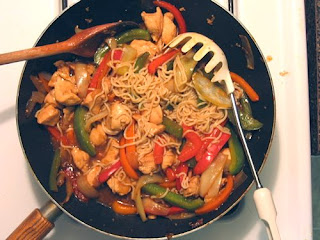
Of course, the deciding factor for any food should be its taste. And in that sense, the shirataki noodles were okay. Not good, not bad. Just okay. They barely have a flavor, actually. I prepared them with peppers, onions, chicken, and Cook’s Illustrated Orange Sesame Stir Fry Sauce, and they blended seamlessly into the mix. I suspect they’d go very well with ramen-style dishes, too.

Ultimately, my verdict is this: unless you have allergies, certain dietary restrictions, or are a VERY beginning dieter, shirataki noodles may not be the best buy. There are tastier, significantly cheaper ways to cut calories.

Have a great weekend everyone. Monday, we're back to bug-free posting. (To repeat: wood, she is being knocked on.)

Orange Sesame Stir Fry with Shirataki Noodles
Serves 3 or 4
Adapted from Cook's Illustrated Best 30-Minute Recipe.


½ cup orange juice
¼ cup soy sauce, plus 1 separate teaspoon
¼ cup low-sodium chicken broth
2 teaspoons toasted sesame oil
2 teaspoons cornstarch
2 tablespoons vegetable oil
1 lb. skinless, boneless chicken breast, cut into 1-inch pieces
3 bell peppers (any kind), sliced into strips
1 medium onion, sliced into thick strips
1 tablespoon grated fresh ginger
2 or 3 garlic cloves, minced
1 bag House Foods shirataki noodles, drained and rinsed

1) In a small bowl, combine orange juice. 1/4 cup soy sauce, broth, sesame oil, and cornstarch. Whisk it all together. Set aside. In a separate medium bowl, coat chicken in the other 1 teaspoon of soy sauce.

2) In a large skillet or wok, heat 2 teaspoons veggie oil over medium-high heat. Cook the chicken until browned. Using tongs, remove it to a dish

3) Add 1 tablespoon veggie oil to the skillet. Add veggies. Saute them until they're crisp-tender, another few minutes.

4) Spread veggies around the perimeter of the pan and add the remaining 1 teaspoon of veggie oil. Add garlic and ginger. Cook 30 to 60 seconds, until fragrant.

5) Add chicken back to skillet and stir everything together. Heat until warmed, a minute or two.

6) Re-whisk orange-sesame sauce, and add it to skillet. Bring everything up to a simmer. Cook for another minute or two, until the sauce is thickened. (It will thicken. Don't worry.) Add noodles and warm through. Serve.

Approximate Calories, Fat, and Price Per Serving
Three servings: 389 calories, 15.4 g fat, $1.87
Four servings: 291 calories, 11.6 g fat, $1.40

Calculations
½ cup orange juice: 55 calories, 0 g fat, $0.16
¼ cup soy sauce, plus 1 separate teaspoon: 37 calories, 0 g fat, $0.40
¼ cup low-sodium chicken broth: 22 calories, 0.75 g fat, $0.06
2 teaspoons toasted sesame oil: 80 calories, 9 g fat, $0.12
2 teaspoons cornstarch: 20 calories, 0 g fat, $0.02
2 tablespoons vegetable oil: 256 calories, 29 g fat, $0.18
1 lb. skinless, boneless chicken breast, cut into 1-inch pieces: 497 calories, 5.4 g fat, $1.69
3 bell peppers (any kind), sliced into strips: 98 calories, 1 g fat, $1.09
1 medium onion, sliced into thick strips: 46 calories, 0.1 g fat, $0.24
1 tablespoon grated fresh ginger: 5 calories, 0 g fat, $0.03
2 or 3 garlic cloves, minced: 11 calories, 0 g fat, $0.12
1 bag House Foods shirataki noodles, drained and rinsed: 40 calories, $1.50
TOTAL: 1167 calories, 46.25 g fat, $5.61
PER SERVING (TOTAL/3): 389 calories, 15.4 g fat, $1.87
PER SERVING (TOTAL/4): 291 calories, 11.6 g fat, $1.40

Friday, April 24, 2009

Pasta with Turkey Sausage and Broccoli Rabe: A Psychic Phenomena

I thought I was a genius.

I thought I was doing something new.

I thought, when I paired turkey crumbles with rapini and piled them into a mound of al dente rotini WITHOUT USING A RECIPE, that I was the first person in the HISTORY OF THE WORLD to try that combination.

I was wrong.

Though the type of pasta and some of the ingredient quantities were slightly different, 20 seconds of research revealed that Giada DeLaurentiis has the exact recipe up on the Food Network site – the same cooking procedure, even. It’s called Orecchiette with Turkey Sausage and Broccoli Rabe, and it has over 100 reviews, making it not quite unknown, either. Doy.

On one hand, this meant I could use her cooking directions as a guide to write my own. On the other hand, it meant I hadn’t discovered the recipe that would win me $12 billion on some kind of Grand Poobah Pasta Cooking Challenge. Giada had already done the dirty work, probably years ago. Dang.

But it wasn’t all bad, see. A few seconds after realizing the similarities, a great feeling of triumph washed over me: I had inadvertently duplicated a real-life professional recipe. One that’d actually been published. Online. In BOOKS, even. When you’re still learning the ropes, that’s a victory on par with golf’s U.S. Open, only waaaaay less boring.

In the end, I may not be a great chef, or a particularly creative one. But I AM, apparently, an accidental psychic, and that’s okay by me. Happy weekend, folks.

Pasta with Turkey Sausage and Broccoli Rabe
Inadvertently adapted from Giada DeLaurentiis.
Serves 3

1 bunch broccoli rabe, stems trimmed
9 ounces rotini, penne, or other small-ish pasta
1 to 1-1/2 tablespoons olive oil
2 links Italian-style turkey sausage, casings removed (I used sweet. – Kris)
3 garlic cloves, minced
Pinch dried crushed red pepper flakes
2 to 3 tablespoons grated Parmesan

1) Bring a big pot of water to a boil. (While this is happening, fill a bowl with cold water and a few ice cubes.) Once the water pot starts boiling, add salt. Add broccoli rabe. Cook 1 minute. Using tongs, transfer rabe to the ice bath. (DON'T DRAIN THE POT.)

2) Once the cooking water is boiling again, add the pasta. Cook until al dente. Drain, saving about 1/2 cup cooking water.

3) In a big pan or skillet, heat oil over medium heat. Add sausage. Brown it, breaking it up with the back of your spoon. It should take 10 or 12 minutes. Add garlic and pepper flakes. Cook 2 minutes, stirring occasionally.

4) Drain broccoli rabe. Add it to sausage. Stir. Add pasta. Stir again. If using, add cooking water now. Add parmesan. Stir until thoroughly combined. Serve.

Approximate Calories, Fat, and Price Per Serving
490 calories, 13.7 g fat, $1.04

Calculations
1 bunch broccoli rabe, stems trimmed: 60 calories, 0 g fat, $0.99
9 ounces rotini, penne, or other small-ish pasta: 913 calories, 4.6 g fat, $0.37
1 to 1-1/2 tablespoons olive oil: 149 calories, 16.9 g fat, $0.18
2 links Italian-style turkey sausage, casings removed: 280 calories, 16 g fat, $0.99
3 garlic cloves, minced: 13 calories, 0 g fat, $0.15
Pinch dried crushed red pepper flakes: negligible calories and fat, $0.02
2 to 3 tablespoons grated Parmesan: 54 calories, 3.6 g fat, $0.43
TOTAL: 1469 calories, 41.1 g fat, $3.13
PER SERVING (TOTAL/3): 490 calories, 13.7 g fat, $1.04

Friday, April 3, 2009

Spaghetti with Asparagus, Egg, and Parmesan: a Mutant Freak of Deliciousness

Though I’m cooking more often now, creating my own recipes continues to scare the living daylights out of me. My self-spawned dishes tend to be three-out-of-five star affairs, meaning they’re servable, but won’t necessarily knock your socks off. See, I’m still mastering certain techniques (read: all of them), and find pairing flavors tougher than Advanced Calculus. (Hey, if mathematicians had to eat their results, they’d have never picked up calculators in the first place.)

So, when I invent something that actually works, it’s like … it’s like … hm … how to express this without resorting to hyperbole?

Oh! I have it. It’s like riding a golden unicorn over a rainbow while world peace breaks out in the background. Or U2 playing an acoustic gig in my living room as I’m hand-fed chocolate-covered strawberries by Raoul Bova. Or taking a permanent vacation from my job, but with eternal severance pay and health benefits. (Dare to dream.)

Okay, maybe I’m exaggerating. But it is pretty cool. And today’s recipe, Spaghetti with Asparagus, Egg, and Parmesan, is one of those rare triumphs.

Tuesday night, I was in a spaghetti mood, but had a use-it-or-lose-it pound of asparagus whiling away in the crisper drawer. With no funghi available, Pasta with Asparagus and Mushrooms was out of the question. So was Roasted Asparagus with Poached Egg and Parmesan, since I reallyreallyreally wanted some pasta. But both recipes fused together? That could work.

And did it EVER. It’s my new favorite comfort food. Creamy and cheesy and asparagus-y, I can see myself eating this over and over again until my death in 2097. (Yes, I’m shooting for 120. Believe in the stars!) And? AND? I would say I could eat 14 bowls of the stuff, but a single serving filled me to the brim.

Of course, should you decide to give it a shot:

1) To cut the fat even further, omit ½ tablespoon olive oil and a little parmesan.

2) Don’t throw out the pasta water. Love it. Be liberal with it. It’s vital to everything.

And that’s it, folks. Have a lovely weekend, and experiment if you get the chance. Occasionally, it’s worth it.

Spaghetti with Asparagus, Egg, and Parmesan
Serves 3

8 oz thin spaghetti
1 tablespoon olive oil
1 pound medium-thin asparagus, rough ends snapped off, cut into 1-inch pieces
Cooking spray
3 eggs
½ tablespoon tap water
Kosher salt and freshly-ground black pepper
2 dashes cayenne pepper
¼ cup grated parmesan

1) Cook pasta ‘til al dente and drain, reserving ¾ cup of cooking water.

2) Heat olive oil in a large skillet over medium heat. Add asparagus and saute for 4 or 5 minutes, stirring occasionally. Add ¼ cooking water and cook for another 3 or 4 minutes, until asparagus is crisp-tender.

3) In the meantime, spray a small nonstick pan with cooking spray. Crack three eggs into it, and add ½ tablespoon tap water. Cover and cook over low heat for a few minutes, until the top of the yolks cloud, but are still soft and runny. Remove from heat.

4) When the asparagus is done cooking, add drained pasta to the pan, stirring to reheat if necessary. Off heat, add the remaining ½ cup of cooking water, cayenne pepper, and salt and pepper to taste. Stir.

5) Ladle pasta into bowls along with 1 tablespoon water/sauce from bottom of pan (or more, if you like). Place egg on top and sprinkle with about 1-1/2 tablespoons parmesan cheese. Break egg, mix everything together, and enjoy.

Approximate Calories, Fat, and Price Per Serving
446 calories, 13.4 g fat, $1.24

Calculations
8 oz thin spaghetti: 800 calories, 4 g fat, $0.33
1 tablespoon olive oil: 119 calories, 13.5 g fat, $0.12
1 pound medium-thin asparagus: 91 calories, 0.5 g fat, $1.99
Cooking spray: negligible calories and fat, $0.03
3 eggs: 221 calories, 14.9 g fat, $0.55
½ tablespoon tap water: negligible calories and fat, $0.00
Kosher salt and freshly-ground black pepper: negligible calories and fat, $0.02
2 dashes cayenne pepper: negligible calories and fat, $0.01
¼ cup grated parmesan:108 calories, 7.2 g fat, $0.68
TOTAL: 1339 calories, 40.1 g fat, $3.73
PER SERVING (TOTAL/3): 446 calories, 13.4 g fat, $1.24

Monday, February 23, 2009

Pasta Puttanesca: Fancy Food for Frugal Entertainers

I’ve learned many things since moving out on my own (make the bed, don’t do drugs, etc.), but perhaps none have been as vital as the following excerpt from a 2003 life skills instruction manual. It was written by a wise, wonderful, unassuming literary icon (note: me) upon her brother’s college graduation, in hopes of inspiring him to put pants on:

“Learn to be at least marginally entertaining. Even if you are aggressively anti-social or covered in boils, the time will come when people want to see you. You must be prepared. Clean your place and don’t leave them to entertain themselves.”

See, with great power (adulthood) comes great responsibility (hosting friends and family). And occasionally, that means feeding people.

Which is why sometimes, in my darkest hours, when all else seems lost, I turn to Rachael Ray. I have conflicting feelings about RR, mostly because she invented “yummo,” which should be banned from all lexicons, everywhere. Still, she knows how to please a crowd. And I respect that.

I respect this Pasta Puttanesca, too. The recipe comes from an episode of 30-Minute Meals called “Quick Italian Classics,” and for the time involved, it’s outstanding. I made it for The Boyfriend on Valentine’s Day, and we almost had babies on the spot. (We didn’t though, Ma.)

Beyond the salty, briny wonder, the best thing about it is the serving size. It will feed roughly 3,000,000 people, and impress at least 2,999,990 of them. When you’re entertaining as a young’un, quality and quantity are good to have.

Should you try it on your own, know the following:

1) If you’re averse to seafood or olives, run far, far, far away. Don’t look back. Then stop and take a breath. Then start running again.

2) Just to restate: this is A LOT OF FREAKING FOOD. The Food Network site claims this will make four servings, which might be true if you live in a family of insatiable giants. In my phenomenally humble opinion, it’ll serve a minimum of six, especially if you include garlic bread or a salad or something.

(THINGS TO PONDER: Can one claim to be “phenomenally humble”? It’s essentially saying you’re the absolute best at being modest, which negates the whole thing. Discuss.)

3) For kicks, we added a drained can of quartered artichoke hearts. (The Boyfriend loves ‘em.) They’re not listed in the original recipe, and are only included as an option here, because they’re somewhat pricey (but highly suggested).

4) I used half black olives and half kalamata. BECAUSE I COULD. MUAHAHAHAHAHA!

So, next time you're forced to feed a crowd, consider the Puttanesca. It could be a valuable part of your adulthood.

Pasta Puttanesca
Makes 6 servings
Adapted from Rachael Ray.


1 pound spaghetti 
2 tablespoons extra-virgin olive oil
4 to 6 cloves garlic, chopped
1 tin flat anchovy fillets, drained
1 /2 teaspoon red pepper flakes
20 oil-cured black olives, cracked away from pit and coarsely chopped
3 tablespoons capers
1 (28 to 32-ounce) can chunky style crushed tomatoes
1 (14.5-ounce) can diced tomatoes, drained
A few grinds black pepper
1/4 cup flat leaf parsley, chopped
OPTIONAL: 1 14.5-oz can artichoke heart quarters, drained

1) Cook pasta in salted water until al dente. Drain and set aside.

2) In a large skillet, combine oil, garlic, anchovies, and red pepper and heat over medium heat. Cook about 3 minutes, until anchovies are completely dissolved. Add olives, capers, tomatoes, black pepper, and parsley (and artichoke hearts, if using). Once it starts to bubble, drop the heat to medium-low and cook 8 or 10 minutes, stirring occasionally.

3) Add pasta to pan. Toss to coat. Serve.

Approximate Calories, Fat, and Price Per Serving
434 calories, 9.3 g fat, $1.50

Calculations
2 tablespoons extra-virgin olive oil: 239 calories, 27 g fat, $0.23
4 to 6 cloves garlic: 22 calories, 0.1 g fat, $0.20
1 tin flat anchovy fillets, drained: 119 calories, 5.5 g fat, $1.59
1 /2 teaspoon red pepper flakes: negligible calories and fat, $0.02
20 oil-cured black olives: 175 calories, 15 g fat, $1.84
3 tablespoons capers: 6 calories, 0.2 g fat, $1.64
1 (28 to 32-ounce) can chunky style crushed tomatoes: 279 calories, 0 g fat, $0.98
1 (14.5-ounce) can diced tomatoes, drained: 82 calories, 0 g fat, $1.19
A few grinds black pepper: negligible calories and fat, $0.02
1/4 cup flat leaf parsley, chopped: negligible calories and fat, $0.49
1 pound spaghetti, cooked to al dente (with a bite): 1680 calories, 8 g fat, $0.80
TOTAL: 2602 calories, 55.8 g fat, $9.00
PER SERVING: 434 calories, 9.3 g fat, $1.50

Thursday, January 15, 2009

Veggie Might: Pumpkin Orzo with Sage ... Chasing the Pumpkin

Penned by the effervescent Leigh, Veggie Might is a weekly Thursday column about the wide world of Vegetarianism.

Sometimes a recipe falls through the cracks and doesn’t get written about right away even though it’s so good I can’t stop thinking about it. Sometimes a recipe is like crack, and once it’s made, it demands to be made again and again. This is both of those recipes.

Pumpkin was one of the few vegetables I managed to freeze from my CSA. I had more of it than I could use, but I didn’t really know what to do with it. When L, the farmer, recommended pairing it with sage, I had no idea that was a common way to serve it. Pumpkin was pretty much found in pie or nowhere growing up at my house.

I poked around the interwebs for a pumpkin-sage recipe, and everything jumped out at me. Unfortunately most of the recipes were so heavy, or drowning in cream and butter, that I gained five pounds in contemplation.

I decided to wing it and make a mostly vegan lasagna with the pumpkin-sage combo. Oh dear. If only I’d followed even part of a recipe or at least taken a photo of the disaster. It was one for the Hall of Shame. There was no sauce to speak of which caused the noodles edges to come out crunchy. The pumpkin puree filling, however, was perfect.

Keeping the part that worked, I switched the pasta to orzo (I have no patience for sweating over a pot of risotto.) and experimented with a rice milk broth to add creaminess without adding a ton of fat. Eureka! A pinch of this, a splash of that: it was just what I tasted in my mind.

This little pot of joy was embarrassingly simple. Especially after I’d toiled so over my failed lasagna. That pan of orange, leathery straps was redeemed by fluffy, sweet-and-savory taste of heaven.

Now that the kinks have been worked out, the variations I have planned for the puree are endless. Any pasta or base grain will work. Oh! I just nearly passed out imagining this with quinoa. I think leafy greens would compliment the pumpkin nicely: a Swiss chard or spinach wilted in the broth stage could add another layer of complexity and give more nutritional punch.

Nothing this easy should taste this amazing. I shed happy tears with every bite. Then I called several people to brag. My doggie even did a little dance. I can’t believe it took me so long to tell you about it. Maybe you should give me your phone numbers.

Pumpkin Orzo with Sage
Serves 4


8 oz orzo
3 c vegetable stock
3 c water

1 1/2 cup pumpkin puree (or squash of your choice)
1 1/4 cup vegetable stock
1/2 cup rice milk
30 sage leaves, cut into ribbons
1 shallot
1 tbsp vegan nonhydrogenated margarine
3/4 tsp salt
20 grinds fresh black pepper
3 tbsp Parmesan cheese (optional, but oh so good)

Pumpkin Puree
1) If you’re starting with a fresh pumpkin or squash, slice in half (lengthwise for butternut and its ilk) and place cut side down on a lightly oiled baking sheet. Bake at 350º for 30 minutes or until tender. Allow to cool and scoop out with a spoon. Puree in a food processor until smooth.

The Sauce
2) Sauté shallots and sage in margarine for 5 minutes over medium heat. Add 3/4 cup of broth and 1/2 cup of rice milk. Allow to simmer for 5 minutes or so.

Meanwhile…The Orzo
3) In a large saucepan, bring 3 cups of broth and 3 cups of water to boil over high heat. Add orzo. Return to a boil and cook for 9 minutes or until pasta is al dente. Drain and set aside.

Back to the sauce...
4) Add pumpkin puree to simmering broth and stir well. Add salt, pepper, and remaining 3/4 cup of broth. Reduce heat and simmer for 10 more minutes on medium low.

5) Stir in Parmesan cheese (if you so choose).

6) Toss over orzo and serve hot.

7) Melt with delight.

Approximate Calories, Fat, and Price per Serving:
290 calories, 1.7g fat, $.73
(With parmesan: 305.6 calories, 5.2g fat, $1.01)

Calculations
8 oz orzo: 840 calories, 4g fat, $.50
3 c vegetable stock: 36 calories, 0g fat, $.39
1 1/2 cup pumpkin puree (or squash of your choice): 73.5 calories, 0g fat, .93
1 1/4 cup vegetable stock: 15 calories, 0g fat, $.16
1/2 cup rice milk: 45 calories, 1.75g fat, $.20
30 sage leaves: 10 calories, 0g fat, $.40
1 shallot: 40 calories, 0g fat, $.20
1 tbsp vegan butter: 100 cal, 11 fat, $.12
3/4 tsp: salt negligible calories and fat, $.02
20 grinds fresh black pepper: salt negligible calories and fat, $.02
(3 tbsp parmesan cheese: 63 calories, 4.2g fat, $1.11)
Totals: 1159.5 calories, 16.8g fat, $29.4 (1222.5 calories, 21g fat, $4.05)
Per Serving: 290 calories, 1.7g fat, $.73 (305.6 calories, 5.2g fat, $1.01)

Friday, January 9, 2009

Jenny Craig's Moroccan Chicken and Orzo: Floppy Hats and Decent Food

When I went away to college in the cold tundra of Western New York, my parents bought me three cookbooks for the journey: Betty Crocker’s Everything You Need to Know to Cook Today, a colossal and ancient compendium of Christmas dishes, and Jenny Craig’s No Diet Required: Recipes for Healthy Living. Betty’s book is still invaluable, the Christmas tome went for $3 in a Williamsburg stoop sale in 2006, and Jenny, well …

I owned No Diets Required for six solid years before ever cracking it open. When it finally happened, I was rewarded with two things: 1) pictures of decent-looking diet food, and 2) pictures of hilariously made-up white women.

Though published in 1997, the pictures of Jenny & Co. could have come from a Kentucky Derby party in the Reagan era. You’ve never seen bigger shoulder pads or floppier hats in your whole life, and the cosmetics are … prominent. But those are just the first few photos. There’s also Jenny on the Beach, Christmas Jenny with the Grandkids, and Jenny Enjoying a Warm Cup of Whatever. Even the more subdued pics are rife with bedazzled mom jeans and intricately embroidered vests, giving the whole affair a vibe of Country Weekend with the WASP Family. Good times.

Here’s the thing, though: when I finally got down to making it, the food was pretty good. No one’s ever going to mistake it for an evening at Le Bernardin, and the salsa recipe calls for a jar of prepared salsa, but still. For someone just learning to cook, it beats the crap out of Hot Pockets.

Located on page 150, somewhere between Cinnamon Chips and Lemon Sorbet Cups, is Moroccan Chicken and Orzo. I first whipped it up a few years ago, when “the kitchen” was still an unfamiliar place of burnt fingers and witchcraft. The recipe called for crazy ingredients like “turmeric” and “cumin,” which at the time, could have read “gorilla spit” and “googly googly goo” for all I knew. (Note: as it turned out, they were readily available in the supermarket.) The whole shebang ended up well, though, and it was a triumph for a culinary nitwit like myself.

Fast forward to 2009, and the dish still holds up. Granted, the spices had to be doubled along the way, but for a quick, one-pot weeknight meal, it doesn’t get much better. Warm and filling, it’s also stellar cold and aces for office leftovers.

In the end, I bow to Jenny and her big ol’ hat. They may look funny, but they know of what they speak.

P.S. Some of my spices come in bulk from the local Muslim grocer, so they might be less expensive than store-bought brands.

P.P.S. Jenny provided the nutrition numbers, so only the price is calculated here.

P.P.P.S. I knew I forgot something last night. I was too busy laughing my face off at 30 Rock (particularly A Blaffair to Rememblack), that I didn’t upload a picture. Until I can get to my camera, please make do with this picture of Tracy Jordan from his famous ‘80s novelty party video, “Werewolf Bar Mitzvah.”

P.P.P.P.S. Edited to add: the photo's been added as of 8:45 EST. Viva la France!

Moroccan Chicken and Orzo
Makes 5 1-cup servings
Adapted from Jenny Craig's No Diet Required.


1 cup orzo, uncooked
2 teaspoons paprika
1 teaspoon ground cumin
1/2 teaspoon salt
1/4 teaspoon turmeric or 1/2 teaspoon saffron threads
1/4 teaspoon ground cinnamon
1 large clove garlic, minced
14-16 ounces chicken breast, cut into bite-sized pieces (1" or smaller)
2 teaspoons vegetable or olive oil
1-1/4 cup chopped onion
1 cup low-sodium chicken broth
1/4 cup golden raisins
1/4 cup fresh cilantro, chopped

1) Cook orzo in salted water until al dente.  Drain and set aside.

2) While orzo is cooking, get out a medium bowl. Add paprika, cumin, salt, turmeric, cinnamon and garlic, and stir to combine. Add chicken and stir until poultry is entirely coated with mix. 

3) In a large nonstick skillet, heat oil over medium-high heat. Add onion. Saute about 4 minutes, until it's a little soft and translucent, stirring occasionally. Add chicken. Brown chicken, stirring occasionally, 6 to 8 more minutes. Pour in broth and raisins. Drop heat back to medium and let it cook for 5 minutes.

4) Kill heat. Remove skillet from burner. Pour cooked orzo into skillet. Stir until the whole shebang is thoroughly combined. Top with fresh cilantro and serve.

Calories, Fat, Fiber, and Price Per Serving
327 calories, 4.3 g fat, 2.4 g fiber, $1.18

Calculations
1 cup orzo, uncooked: $0.40
2 teaspoons paprika: $0.08
1 teaspoon ground cumin: $0.02
1/2 teaspoon salt: $0.01
1/4 teaspoon turmeric or 1/2 teaspoon saffron threads: $0.02
1/4 teaspoon ground cinnamon: $0.01
1 large clove garlic, minced: $0.04
14-16 ounces chicken breast: $1.99
2 teaspoons vegetable or olive oil: $0.07
1-1/4 cup chopped onion: $0.30
1 cup low-sodium chicken broth: $0.50
1/4 cup golden raisins: $0.45
1/4 cup fresh cilantro, chopped: $0.99
TOTAL: $5.88
PER SERVING (TOTAL/5): $1.18

Monday, December 22, 2008

American Chop Suey and a Tale of Two Dinners

This weekend, I made a pair of vastly different meals: Pork Shoulder with Guinness, Dried Cherries, and Sweet Potatoes from Daniel Boulud’s 2006 Braise cookbook, and American Chop Suey, from my favorite long-defunct food blog, Words to Eat By.

The first dish took more than five hours and ran about $20, while other was finished in 45 minutes and cost a little over $5. Both were tasty and satisfyingly filling – perfect comfort foods for -47°F. Alas, only one will make frequent repeat performances, and it ain’t the dinner with 14 ingredients, all found in different stores (a.k.a. the pork thingie).

Don’t get me wrong, I really liked Boulud’s recipe. It WAS delicious. Plus, I got to sear, sauté, braise, and marinate, and didn’t burn myself beyond recognition during the Brown Pork in Very Hot Oil portion of the program. Sadly, it’s a once-in-awhile kinda dish, as the expense and ingredient list are too prohibitive for regular appearances.

American Chop Suey, on the other hand … this is going into rotation. Essentially macaroni and ground turkey (with a cup of vegetables thrown in for posterity), it’s not rocket science. But I LIKED IT. And it’s got crazy potential, too. Like:

Add Whatever You Have Lying Around the Fridge Potential: good
Double the Recipe and Portion it Out for Lunch Potential: very good
Leftover Potential: excellent.
“Will My Kids Like It?” Potential: off the charts

Though it does fall short in other areas:

Freezer Potential: not so much
Crockpot Potential: *vomits on office chair*

All in all, it’s a keeper, and I highly suggest it for a weeknight meal. For the holidays, go with the Pork Shoulder, though. If you have the time, cash, and pure brute strength, I can definitely e-mail you the recipe.

American Chop Suey
Makes 5 nice-sized servings
Adapted from Words to Eat By

1 tablespoon olive oil, divided
1 ½ lbs ground turkey
½ lb (2 c.) uncooked elbow macaroni
½ cup minced onion
½ cup chopped red bell pepper or celery (or pepper AND celery – Kris)
2 8-oz cans tomato sauce
1 cup water
1 teaspoon salt
¼ teapsoon pepper
1-1 ½ tablespoon Worcestershire sauce

1) In a large nonstick skillet or saute pan, heat 1/2 tablespoon olive oil over medium-high heat. Add turkey. Cook until browned, breaking it up with the back of a spoon as you go. Remove turkey and place on plate or in bowl for time being.

2) Wipe the pan with a paper towel to get some of the grease out. Add remaining 1/2 tablespoon olive oil and heat over medium-high heat. Add macaroni, onion, pepper, and celery (if having). Cook for 5 or 6 minutes, until onion is soft and a little translucent, stirring occasionally. Add meat back into pan. Stir.

3) Add tomato sauce, water, salt, pepper, and Worcestershire sauce. Stir everything and cover pan. Drop heat to medium-low and simmer about 20 or 25 minutes.Voila!

Approximate Calories, Fat, and Price Per Serving
427 calories, 13.4 g fat, $1.09

Calculations
1 tablespoon olive oil: 139 calories, 13.5 g fat, $0.12
1 ½ lbs ground turkey: 960 calories, 48 g fat, $3.73
½ lb (2 c.) uncooked elbow macaroni: 811 calories, 4.1 g fat, $0.33
½ cup minced onion: 34 calories, 0.1 g fat, $0.12
½ cup chopped red bell pepper or celery (or pepper AND celery – Kris): 14 calories, 0.1 g fat, $0.39
2 8-oz cans tomato sauce: 173 calories, 1 g fat, $0.50
1 cup water: negligible calories and fat, FREE
1 teaspoon salt: negligible calories and fat, $0.01
¼ teapsoon pepper: negligible calories and fat, $0.01
1-1 ½ tablespoon Worcestershire sauce: 5 calories, 0 g fat, $0.22
TOTAL: 2136 calories, 66.8 g fat, $5.43
PER SERVING (TOTAL/5): 427 calories, 13.4 g fat, $1.09

Tuesday, November 4, 2008

City Kitchen Chronicles: Garlicky Long Beans and Farmers Markets

City Kitchen Chronicles is a bi-weekly column about living frugally in Manhattan. It's penned by the lovely Jaime.

This past Saturday my mom came into the city for some quality time. We went out for lunch, but before that I took her along on my favorite Saturday morning fixture: shopping for vegetables.

I am a wholehearted devotee of farmers markets. Even before Michael Pollan and his amazing book, The Omnivore’s Dilemma, laid out for me the brutal and beautiful repercussions of how we get our food (and subsequent case for local eating), I’d gotten in the habit of buying my veggies from the weekend farmers market that’s just a few blocks from my apartment.

When I moved to this neighborhood a year ago last summer, my eating and cooking habits changed, largely by virtue of now living alone. I started cooking more, and I was suddenly a short, lovely walk away from fresh, local veggies every Saturday morning. I’ve since traded most of those quick jaunts for a more time-intensive but even more rewarding trip to the mother of all NYC farmers markets, at Union Square.

Every week I savor the hour I give myself to stroll back and forth through the stalls (once through to see what’s good and what’s cheap, and then buying on a second pass), but my mom’s reactions reminded me how special these mornings are. “Oh, look at that broccoli! It’s gorgeous!” “Ohh, those Macouns look amazing!” “They look so fresh!” That last one was for Brussels sprouts still on the stalk, a treat you never see at the supermarket.

In the end, for all its fresh and delicious bounty, the greenmarket wasn’t exactly my suburban mom’s speed. She found herself fumbling with cash and her bags whenever she went to buy something, and the jostling crowds can be a lot. “I need a shopping cart,” she said more than once. New York City doesn’t scare her – she lived here when she was my age – but there’s a way to get zen with the slow-walking busyness of the farmers market that I realized I’ve acquired over the last year.

Then, that evening, after my mom had left, I went to Target to buy socks and conditioner and got my own taste of overstimulation anxiety. To each her own.

One of the best things about the farmers market – beyond fresh produce, environmentally-friendly eating, supporting local businesses, and damn tasty food – and especially of big markets like the one at Union Square, is that it gets me to try new veggies. When collards were cheap, I started buying collards. When zucchini went out of season, I tried – and discovered I love – cauliflower and Brussels sprouts. And every so often I’ll spot a strange and intriguing vegetable that’s cheap and looks promising.

Over the summer I tried all sorts of weird wild greens like lambsquarter and purslane, loving both. More recently I took a chance on long beans.

See, they’re like darker, tougher string beans, but loooooong.

A sign at the stall said they have a stronger, meatier texture, and suggested braising the beans. I tend to sauté everything, and had a feeling these beans would stand up to that pretty well.

And damn was I right! I went with olive oil and a metric ton of garlic, and was not disappointed. Cannellini beans add protein and creaminess, almost dissolving into a sauce over some hearty whole wheat pasta. The lemon juice cuts the salt and oil without tasting lemony. The long beans’ flavor isn’t super strong, but they hold up well and have a really interesting texture. Keeping the garlic pieces big and cooking it slow makes this more tasty and less breath-killing.

Garlicky long beans and beans
makes 4 servings (or so)

1/2 lb long beans, cut into three-inch (or so) pieces.
4 cloves garlic
1 can Cannelinni beans, drained and rinsed
juice of 1 lemon
1 1/2 cups (dry) whole wheat pasta (rotini or penne will work well)
salt and pepper

1) Cut up 4 cloves of garlic in various ways – the smaller the pieces, the garlickier the food. One or two minced, two sliced very thin, and one however you like will yield a good mix of sizes and heat.

2) Get your pasta cooking. (I hope it’s okay if I don’t tell you how to cook pasta. Err on the al dente side for this, though, cause the beans will add a lot of mush.)

3) Heat 1 T olive oil over medium-low heat. Saute garlic until starting to get color.

4) Add long beans, and toss. Saute over medium heat until they’re tasty and just about done. (10 min or so, but taste as you go.)

5) Toss in Cannellini beans, salting and peppering to taste. (The beans will take a lot of salt.)

6) Toss cooked pasta with 1 T olive oil, then mix in the bean & bean mixture and lemon juice, or serve the beans over the pasta. However you like.

Approximate Calories, Fat, and Price Per Serving
4 servings: 431 calories, 8 g fat, $0.88

Calculations
1/2 lb long beans: 96 calories, 0 g fat, $2.00
4 cloves garlic: 18 calories, 0 g fat, $0.10
1 can Cannellini beans: 1,045 calories, 3 g fat, $0.70
2 T olive oil: 239 calories, 27 g fat, $0.20
juice of 1 lemon: 12 calories, 0 g fat, $0.20
1 1/2 cups (dry) whole wheat pasta: 315 calories, 2 g fat, $0.30
salt and pepper: negligible calories and fat, $0.02
TOTAL: 1,723 calories, 32 g fat, $3.52
PER SERVING (TOTAL/4): 431 calories, 8 g fat, $0.88

(Union Square photo provided by Flickr member wallyg.)

Friday, October 31, 2008

Orzo with Sausage, Peppers, and Tomatoes: a Very Giada Halloween

People knock her for the foxiness factor, but I’m a Giada DeLaurentiis fan, and I’ll tell you why:

1) Her food is generally solid, always from scratch, and pretty easily prepared on weeknights after work.

2) If I ran a blog called “Expensive Unhealthy TOTALLY FREAKING DELICIOUS,” her Aunt Raffy’s Turkey Sausage and Chestnut Stuffing would be the first recipe on it.

3) She occasionally does photo shoots covered in tomato sauce. The pics aren’t particularly appealing any other day of the year, but on Halloween … awesome. They make perfect accompaniments to an otherwise unscary blog post. (Thanks, G!)

Today’s recipe, Orzo with Sausage, Peppers, and Tomatoes comes from Giada’s newest cookbook, titled … wait for it … Giada’s Kitchen. (Rejected suggestions: Giada's Dining Room, Giada Cooks, Giada Makes Food Then Writes a Recipe and Publishes it in a Book.)

Serious Eats posted on the dish recently, and it’s a bit different from the one found on the Food Network site. For one, jarred peppers replace fresh ones, and parmesan is used instead of Ricotta Salata. Sure, these’ll impact the flavor a bit, but they’re nice cash-saving steps for this time of year, when summer produce is kaput and the Dow’s hitting negative numbers.

I prepared the dish Tuesday night, and was impressed by its simplicity and clean taste. The chicken broth lends a nice depth to the orzo, and the turkey sausage adds a slight saltiness that eliminates the need for actual salt. The Boyfriend liked it as well, and I would have served it to my visiting sister L, if she ate tomatoes, peppers, or anything without the word “tot” or “Diet Pepsi” in the title.

Should you accept the challenge, two notes to … uh, note:

1) This is a tad heartier than the meals that usually appear on this site, but it’s still quite healthy for a pasta dish, which is why it’s here. To reduce the calories or fat further, you could cut down on the olive oil, use water instead of chicken broth, or even take out some parm. (Though – I don’t suggest that last one. Parmesan is pretty key here.)

2) If I make it again, I'd make one change (and it would only be this one): I’d reduce the orzo by about a quarter. There was a bit too much in proportion to the other ingredients. (For the purposes of this post, though, I kept the recipe as Giada wrote it.)

And that’s all, folks. Hope you have a lovely Halloween, and no one TP's your apartment. (Hey you kids! Stop that!) See you Monday.

Orzo with Sausage, Peppers, and Tomatoes
Makes 4 to 6 servings
Adapted from Serious Eats and Giada's Kitchen by Giada de Laurentiis.

3 cups chicken broth
1 pound orzo pasta
2 tablespoons olive oil
2 links (7 ounces total) mild Italian turkey sausage, casings removed
1 garlic clove, minced
2 jarred roasted red bell peppers, cut into 1/4-inch strips
2 plum tomatoes, chopped
1/4 teaspoon red pepper flakes (optional)
2 tablespoons chopped fresh flat-leaf parsley leaves
Salt and freshly ground black pepper
1/2 cup freshly grated Parmesan cheese

1) In a large saucepan, combine 3 cups of water with chicken broth. Turn the heat to high and bring to a boil. Add pasta and cook until al dente. Drain, making sure to reserve 1/2 cup of the pasta water.

2) While pasta is boiling, get out a large skillet. Heat oil in it over medium-high heat. Add turkey sausage and cook around 4 minutes, breaking it up with the back of a spoon as you go. (It should be cooked through, but not quite browned.) Add garlic. Cook until fragrant, 30 to 60 seconds. Add bell peppers, tomatoes, and red pepper flakes (if using). Saute 2 or 3 minutes, until everything is heated through.

3) Combine pasta, sausage mixture, and 1/2 the parsley in a large serving bowl. Salt and pepper to taste. If you need the pasta water to moisten it up, add it now. Mix well. Sprinkle parmesan and the rest of the parsley on top. Serve.

Approximate Calories, Fat, and Price Per Serving
5 Servings: 491 calories, 13 g fat, $1.33

Calculations
3 cups chicken broth: 50 calories, 0 g fat, $1.20
1 pound orzo pasta: 1621 calories, 8 g fat, $0.99
2 tablespoons olive oil: 239 calories, 27 g fat, $0.20
2 links (7 ounces total) mild Italian turkey sausage, casings removed: 280 calories, 16 g fat, $0.98
1 garlic clove, minced: 4 calories, 0 g fat, $0.03
2 jarred roasted red bell peppers: 20 calories, 0 g fat, $0.99
2 plum tomatoes, chopped: 22 calories, 0.2 g fat, $0.54
1/4 teaspoon red pepper flakes (optional): negligible calories and fat, $0.01
2 tablespoons chopped fresh flat-leaf parsley leaves: 3 calories, 0.1 g fat, $0.33
Salt and freshly ground black pepper: negligible calories and fat, $0.01
1/2 cup freshly grated Parmesan cheese: 216 calories, 14.3 g fat, $1.36
TOTAL: 2455 calories, 65.6 g fat, $6.64
PER SERVING (TOTAL/5): 491 calories, 13 g fat, $1.33

Related Post